
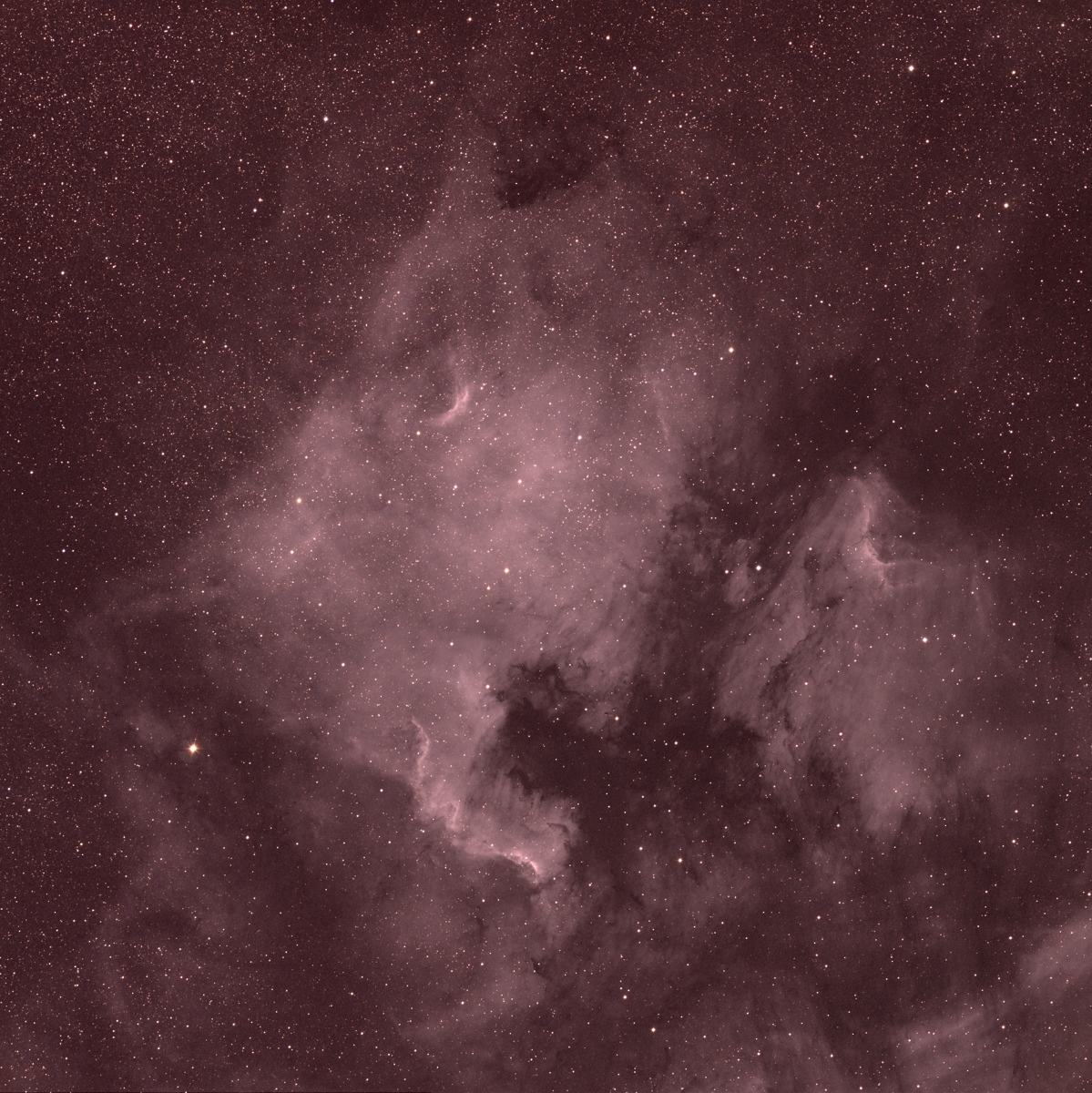
(Click here for additional images: h-alpha only, and very large color version)
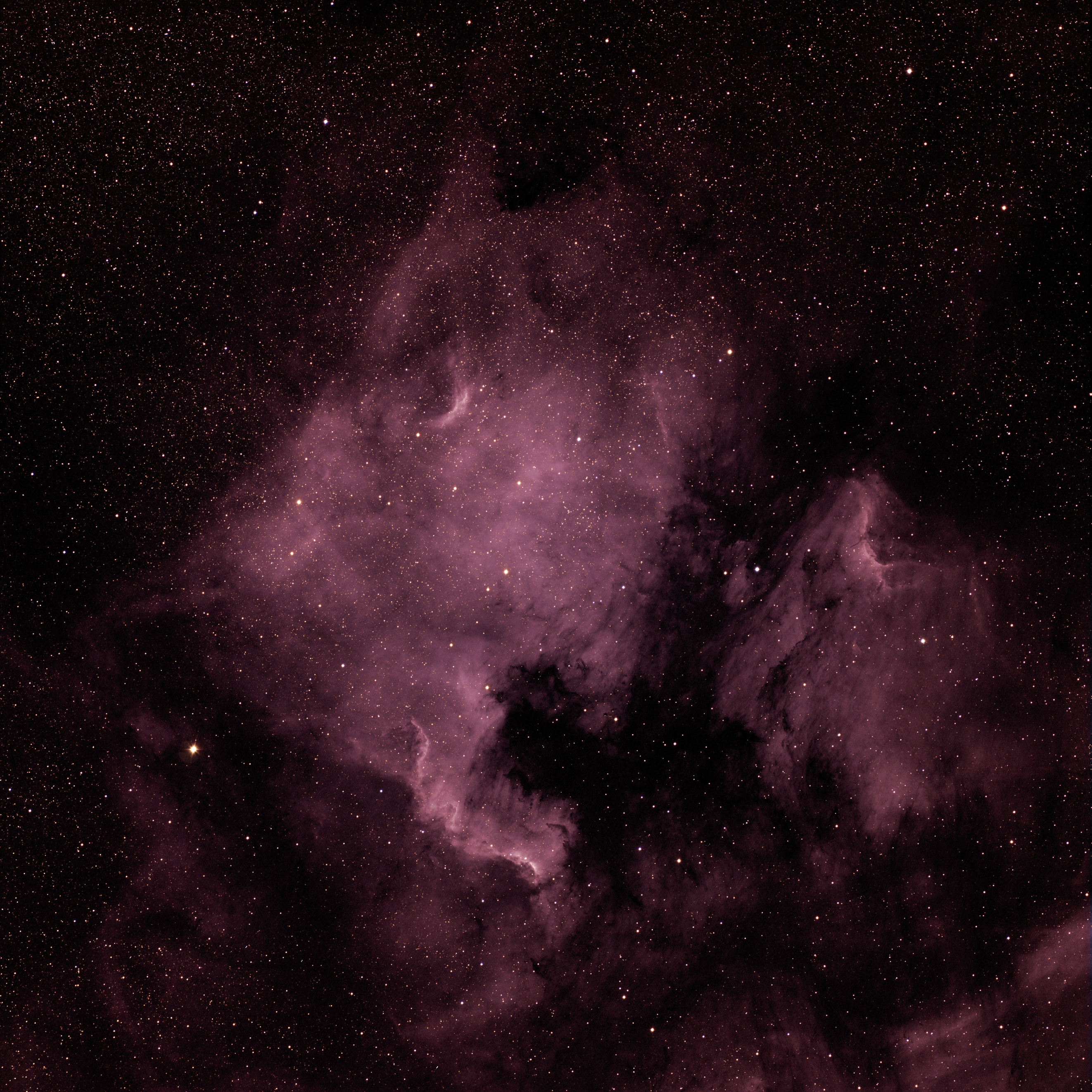
NGC 7000, aka the North American Nebula
This emission nebula in the Constellation of Cygnus (on the left in our image) is famous partly because it resembles North America. Together with the Pelican Nebula (right) it measures about 50 light-years across, and is located about 1,500 light-years away. The two bright nebulae are separated by a dark absorption cloud and are the site of active star formation. Much of the glow results when electrons and ionized hydrogen recombine. It is still unknown which star or stars ionize the red-glowing hydrogen gas. There is also an Open Star Cluster (NGC 6997) involved, plus several other dark nebulae (dust clouds) that are included in Barnard's Catalog of dark nebulae. These nebulae are north-east of bright star Deneb can be seen with binoculars from a dark location. They look particularly spectacular in a small refractor using an O-III filter.
IC 5070 & IC 5067, aka the Pelican Nebula
This less luminous nebula resembles a pelican, and is thus dubbed the "Pelican Nebula". This area is a particularly active mix of star formation and evolving gas clouds. The light from young energetic stars is slowly transforming the cold gas into hot gas, with the advancing boundary between the two known as an ionization front. Particularly dense filaments of cold gas are seen to still remain.
The Kopernik images of these nebulae:
Our image (click here for additional images: h-alpha only, and very large color version) captures the North American and Pelican nebulae, bright ionization fronts, and fine details of the dark dust clouds. There is also an embedded Open Star Cluster and several dark nebulae. In the image above hot hydrogen gas glows in red. The image is a combination of h-alpha and broadband color data taken under near full moon conditions, on the night of August 11/12 2011. Exposure times: R:G:B:Ha = 15, 15, 15, and 21 minutes.
The camera: was a FLI ProLine PL16803, the filter wheel was the FLI CenterLine and the focuser is an FLI Atlas focuser. The filters are Baader Planetarium LRGB and 7nm Ha.
Imaging scope: Takahashi FSQ-106N 106mm F/5 "Quadruplet Fluorite Apochromatic Refractor".
Piggybacking Mount/Scope: Optical Guidance Systems RC20 and 100 German Equatorial mount. We did no guiding for this image.
Imaging team: Kopernik Astro Society Members Jim Moronski, Justin Van Tassel, Art Cacciola, and George Normandin. Jim owns the Takahashi 106mm refractor, and the company he co-owns (Finger Lakes Instrumentation) owns the camera. The imaging camera and refractor were riding on Kopernik Observatory's 20-inch Optical Guidance Systems telescope. G. Normandin processed the images. Jim lifted the 150 lbs of counterweight over his head to balance this rig, while the rest of us held up the 200+ lb scope combo until balanced.
George Normandin, KAS
August 14th, 2011