Dreyer's description in the New General Catalog (NGC):
Considerably faint, pretty large, irregularly round.
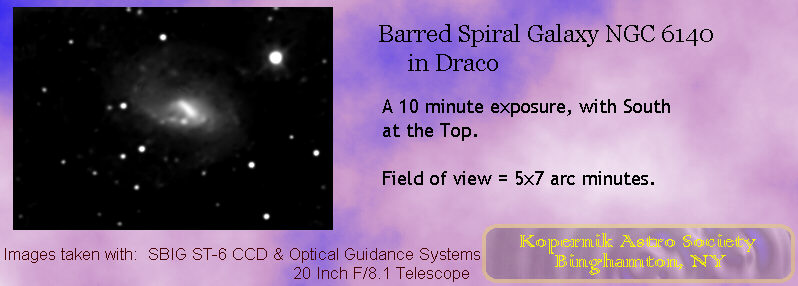
This galaxy has a strangely shaped, bright nucleus with a disk of very low surface brightness. The brightest spiral arm contains a string of knots that are probably H-II star forming regions. Based on the published red shift, (and a Hubble Constant of 62 Km/sec per Mpc) a rough distance estimate is 48 million light years, with a diameter of about 87,600 light years.
Click below to

George Normandin, KAS
December 1st, 2000