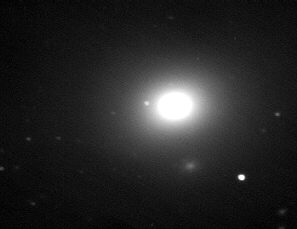
This is a 10 minute exposure with
an ST-6 CCD camera thru Kopernik's 20-inch telescope. The field of view
is about 5x7 arc minutes, with south at the top.
Quote from the Deep
Sky Field Guide to Uranometria 2000:
Very bright center, smooth nebulosity,
faint envelope in outer parts. Companion superimposed at 1.4 minutes
North East. (This is 16.7 magnitude elliptical galaxy PGC 40659
seen below M-86 in the Kopernik image. Also, note another galaxy in the
lower right of the image; it's 18.9 magnitude elliptical galaxy PGC 40691)
Quote by Charles
Messier (March 18th, 1781): “Nebula
without star in Virgo on the same parallel and very near the nebula No.
84 above: they both have the same appearance and are seen together
in the same field in the telescope.”
Quote from
Burnham's Celestial Handbook: M-86
is one of the eccentrics of the Virgo Galaxy Cluster, since it shows no
red shift at all....... If it is actually a member of the Virgo aggregation,
it must have an abnormally high individual space motion, and is possibly
escaping from the cluster. There is the possibility, also, that M-86 is
actually a foreground system, merely seen in the same direction as the
Virgo Cloud, but actually much closer to us; this was the solution adopted
by E. Holmberg, who found a probable distance of slightly under 20 million
light years, an absolute magnitude of -19.1, and a computed mass of about
130 billion solar masses. M86 is one of the redder galaxies in this region,
with an integrated spectral type of about G7.