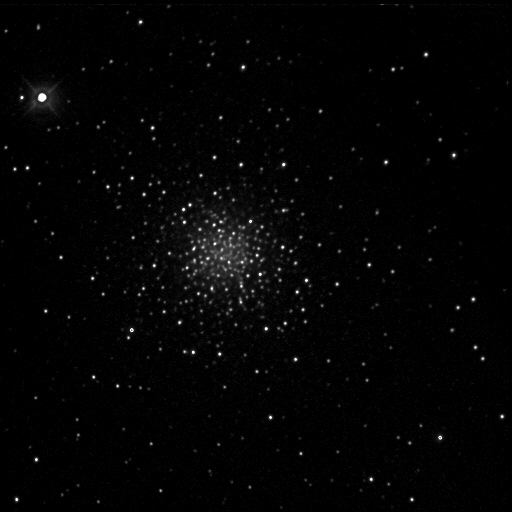
CCD image taken with an ST-9E CCD camera thru Kopernik's
20-inch F/8.1 telescope working at F/4. The field of view is about 16.3x16.3
arc minutes. Exposure = 11 minutes.
CCD image taken with an ST-9E CCD camera thru Kopernik's
20-inch F/8.1 telescope working at F/4. The field of view is about 16.3x16.3
arc minutes. Exposure = 11 minutes.
Quote by Charles Messier (April 9th, 1780): “'Nebula without stars in Hydra; it is very faint, very difficult to see in the telescope; near to it is a 6 mag. star.”
Pierre Mechain discovered M-68 in 1780. However it was not until 1786 that William Herschel first recognized it as a globular star cluster.
This is a very rich and concentrated cluster consisting of at least 100,000 stars. However, because of it’s small size, moderate distance, and relatively dim stars, it is bested viewed in a 10 inch or larger telescope. Kopernik’s 20 inch resolves it nicely.
Although a distance and size are given above, these figures are not as accurate as those for closer globulars. The largest (and most recent) estimate is: distance = 100,000 l.y., diameter = 100 l.y.
Note: Generally, if your telescope will show stars down to the magnitude of the horizontal branch stars, you will be able to visually resolve a globular cluster.
Click below to

George Normandin, KAS
July 5th, 1997
Revised July 18th, 2001