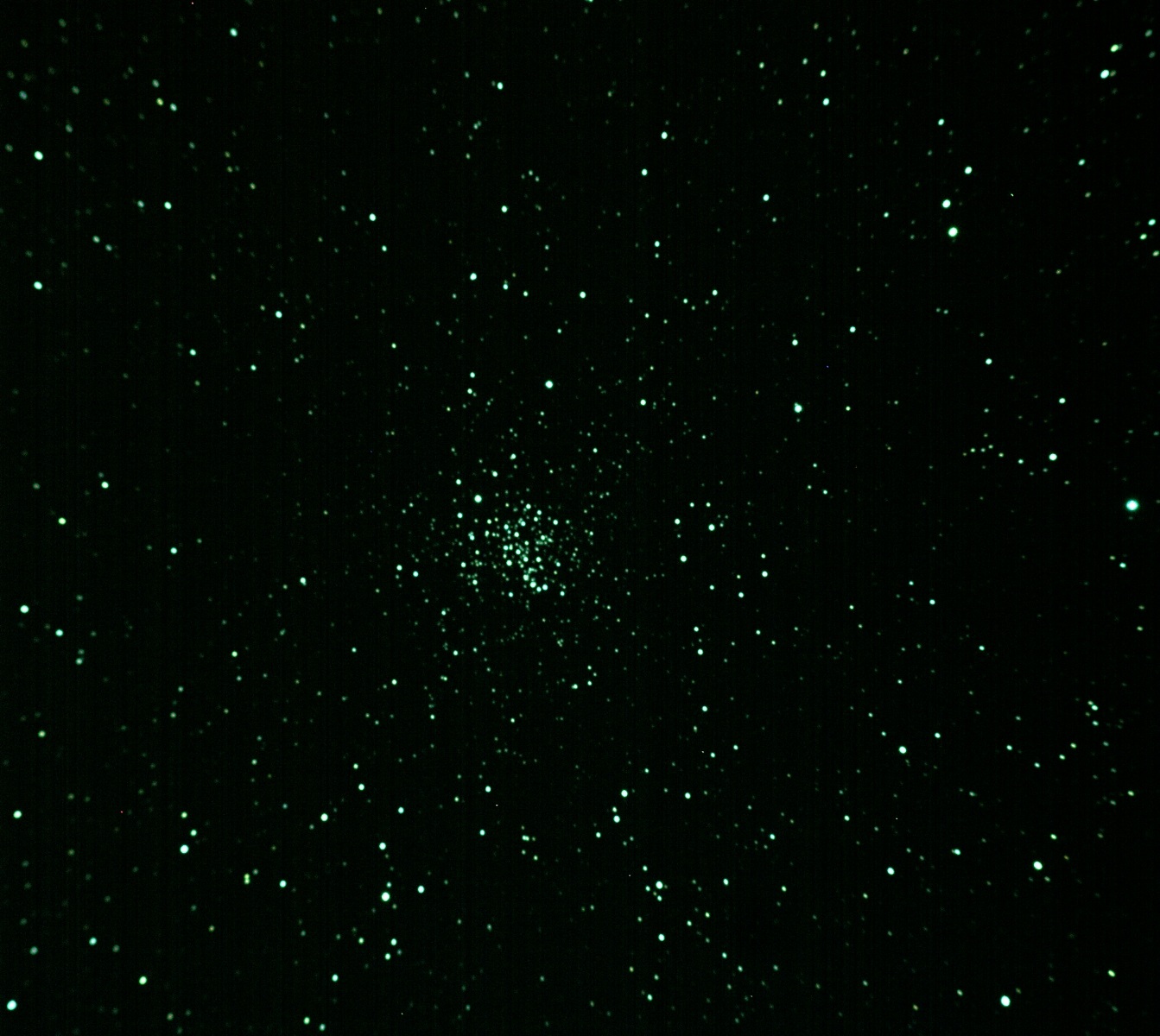
Open star cluster M-67 was discovered by Johann Gottfried Koehler of Dresden Germany sometime between 1772 and 1779.
J.G. Koehler (1779):
'A fairly discernible nebula of oblong shape near Alpha Cancri.'
Charles Messier (April 6th, 1780):
''A cluster of small stars with nebulosity below the southern claw of the Crab. The position determined from the star Alpha.'
William Herschel (1783):
'A very beautiful and pretty much compressed cluster of stars, easily to be seen by any good telescope and in which I have observed above 20 stars at once in the field of view of my great telescope with a power of 157.'
Quote from Dreyer's New General Catalog(NGC) for NGC 2682:
Remarkable! Cluster, very bright, very large, extremely rich in stars, little compressed, stars of magnitude 10 to 15; = M-67.
M-67 contains about 500 stars between magnitude 10 and 16 and has a very large number of even fainter stars. It is believed to be one of the oldest of all galactic clusters, most estimates being between 4 and 5 billion years. Its stars contain elements heavier than helium like the sun (but unlike the stars in the globular star clusters). It is very dense and lies well above the galactic plane. Therefore it is fairly free from much of the disrupting effects of the Galaxy's gravitational forces.
The best distance and diameter estimates are: distance = 2,500 light years, diameter = 12 light years.
George Normandin, KAS
March 28th, 2008