A 80 minute exposure thru Kopernik's
20-inch R-C Cassegrain telescope working at F/5.2.
The field of view is about 20x20 arc minutes with North at the Top.
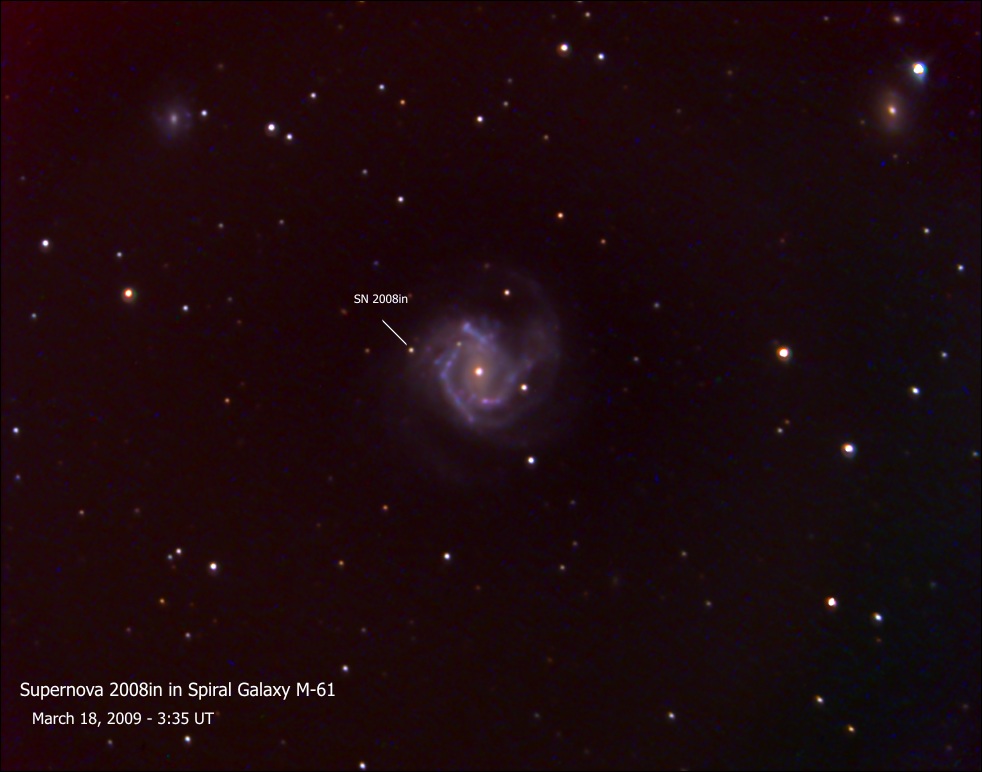
On December 26th 2008 amateur astronomer Koichi Itagaki (Japan) discovered his second supernova in M-61. It was magnitude 14.9 at discovery. Later observations show that it is a Type IIp supernova.
The first Kopernik image shown here (lower) was taken at 3:35 UT on March 18th, 2009. Our magnitude estimates are: red = 15.38, and blue = 16.92.
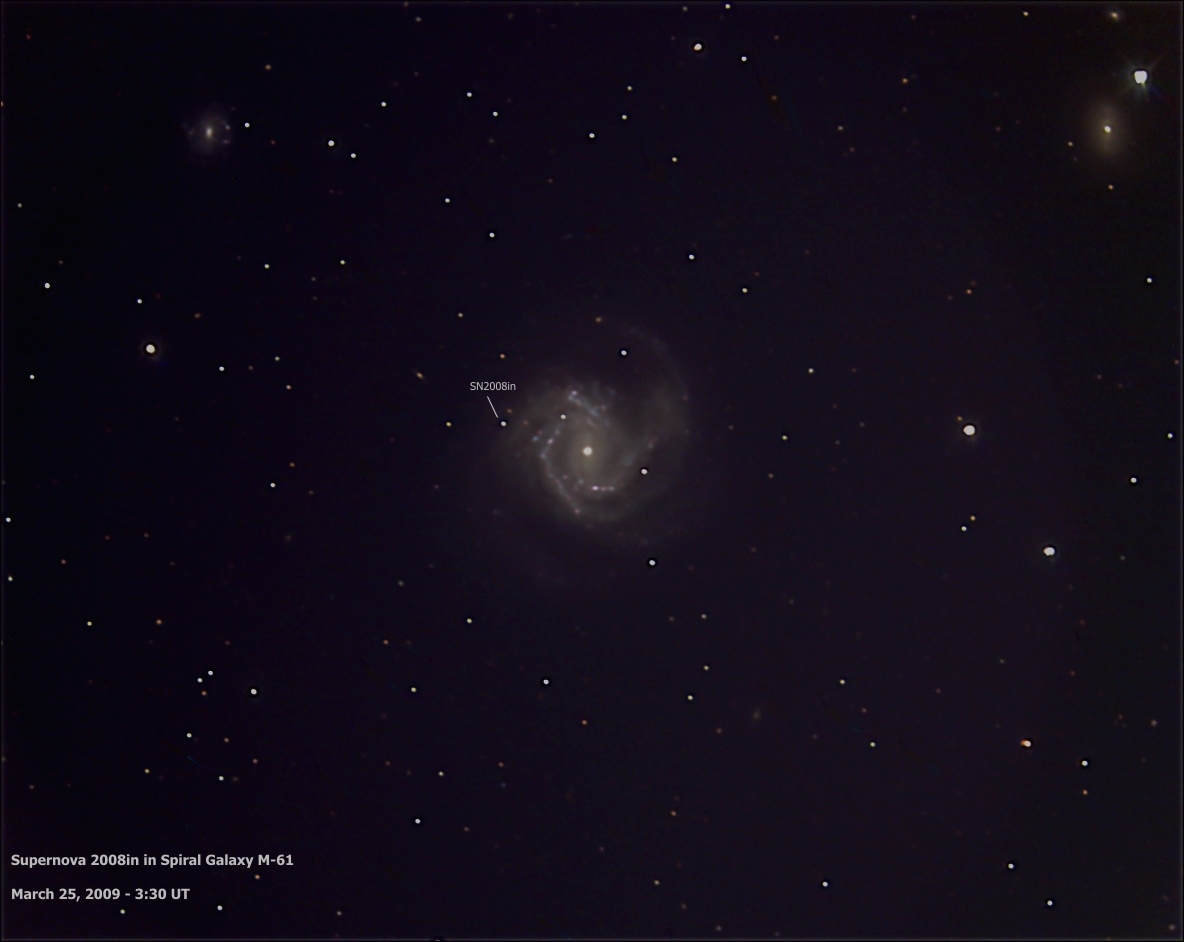
The second image (middle) was taken at 3:30 UT on March 25th, 2009. Magnitude estimates: red = 15.45, blue = 16.79.
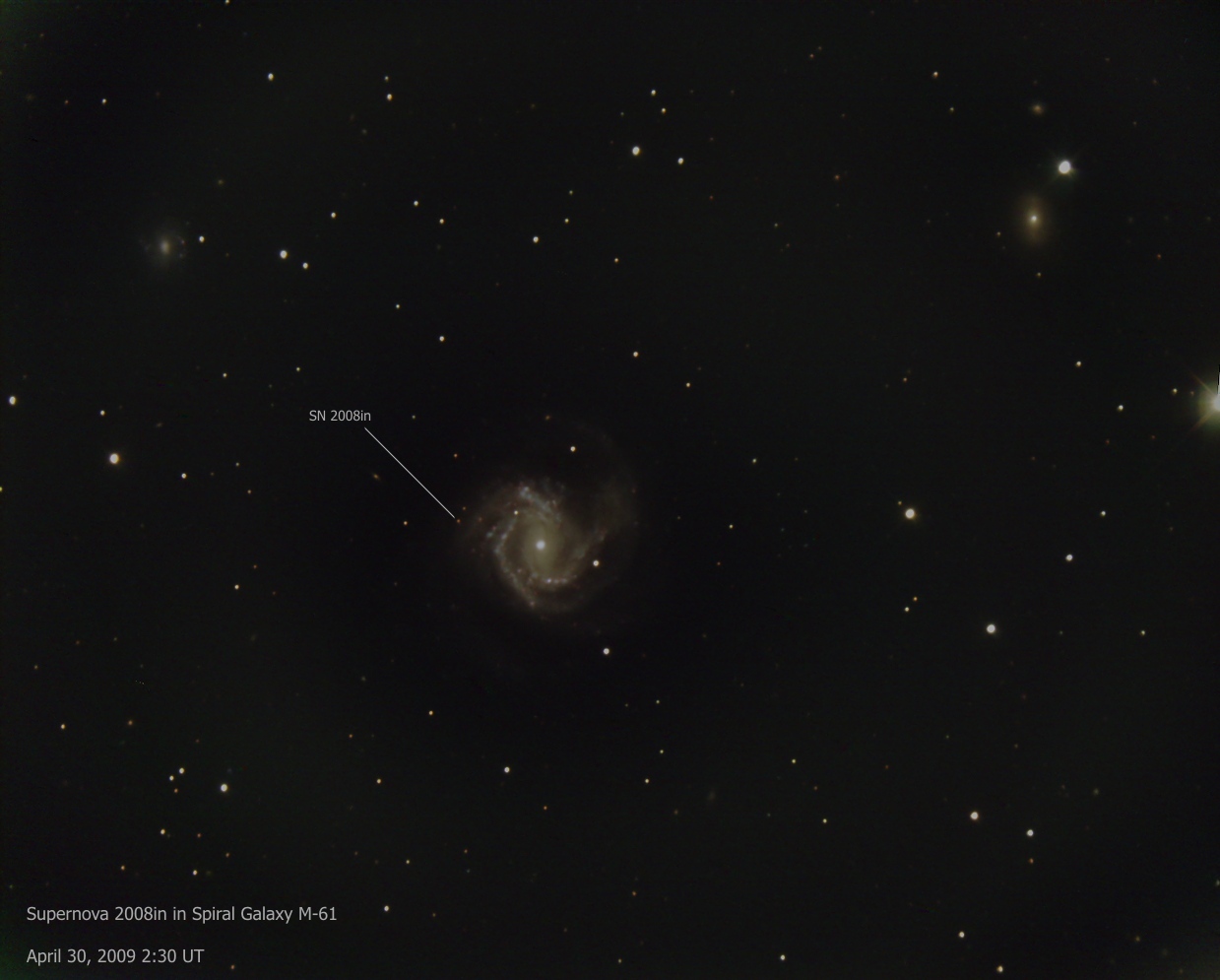
The third image (top) was taken at 2:30 UT on April 30th, 2009. Magnitude estimates: red = 17.04, blue = 18.79.
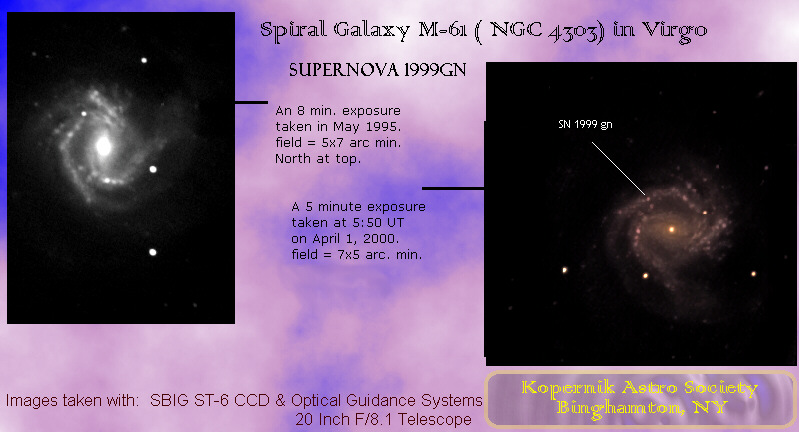
International Astronomical Union Circular 7335 reported the discovery on December 17th 1999 of a supernova in M-61 by amateur astronomer Alessandro Dimai, of Cortina, Italy. It was magnitude 16.0 at discovery. Later observations show that it is a Type II supernova discovered before it had reached its peak brightness and that the ejected material was expanding at 5,300 km per second. Previous supernovae in M61 were 1926a, 1961i, and 1964f.
The Kopernik image shown here was taken at 5:50 UT (1 am local time) on April 1st, 2000, using our 20 inch telescope. The supernova is about 15.5 magnitude in our image.
Spiral Galaxy M-61 ( NGC 4303 ):
B. Oriani, May 5th, 1779: "Very pale looking, exactly like the comet."
C. Messier, May 11th, 1779: "A nebula, very faint and difficult to distinguish. M. Messier mistook this nebula for the comet of 1779 on the 5th, 6th, and 11th of May. On the 11th he found it was not a comet but a nebula which was on its path and in the same part of the sky."
Italian astronomer B. Oriani discovered M-61 in May 1779, while observing the comet of that year. Messier found it a few nights later and at first mistook it for the comet.
M-61 is a nearly face-on spiral galaxy with a small bar found in the Constellation of Virgo. It is probably a part of the Coma/Virgo galaxy cluster. Various sources state that it has a distance of about 40 million light years, with a diameter of 60,000 light years. M-61 may belong to the class of galaxies with active nuclei known as Seyfert galaxies. (see also M-77) Filippenko & Sargent (1985) showed that the nuclear spectrum is that of a H II region, each line, however, having a broad base suggesting the presence of a faint Seyfert 2 nucleus. Later observations seem to show that the H II region forms a ring around the nucleus and that prodigious star formation is occurring in the galaxy. A rather unusual effect is seen in the spiral structure of this galaxy. The arms show several sudden changes of direction at sharp angles, producing an over-all polygonal structure, and there is an exceptionally bright and thick star cloud in the arm on the north edge of the system. Supernovae were recorded in M-61 in 1926, 1961, and 1964, and 1999.
Quote from A. Sandage's The Hubble Atlas of Galaxies, 1965:
The galaxy has some characteristics of a barred spiral...... Two thin dust lanes (width about 150 parsecs) wind out through the pseudo bar to the inside of the beginning of the two main luminous arms. Many faint arms are present on the outside of the two bright ones. The many knots in the brighter arms are undoubtedly HII regions.
Two Spiral Galaxies (in addition to M-61) appear in the Kopernik image above. They are both probable members of the Coma/Virgo galaxy cluster, and thus are true companions of M-61, but at slightly greater distance.
NGC 4303A ( aka NGC 4301, on the left in the image above ) is a Barred Spiral Galaxy with several prominent blue knots in its spiral arms. NGC 4292 (on the right in the image) is also a Barred Spiral Galaxy with spiral arms that nearly complete a pseudo ring structure. A 10-inch telescope will show both as faint smudges of light in the same field as M-61.
Classification: SAB(s)cd
Mixed
Barred - Non-Barred Spiral, Mixed S-shaped
Classification: (R)SB(r)0^0^
Barred
Spiral, with pseudo Outer Ring, and an Inner Ring
George Normandin, KAS
May 2nd, 2009