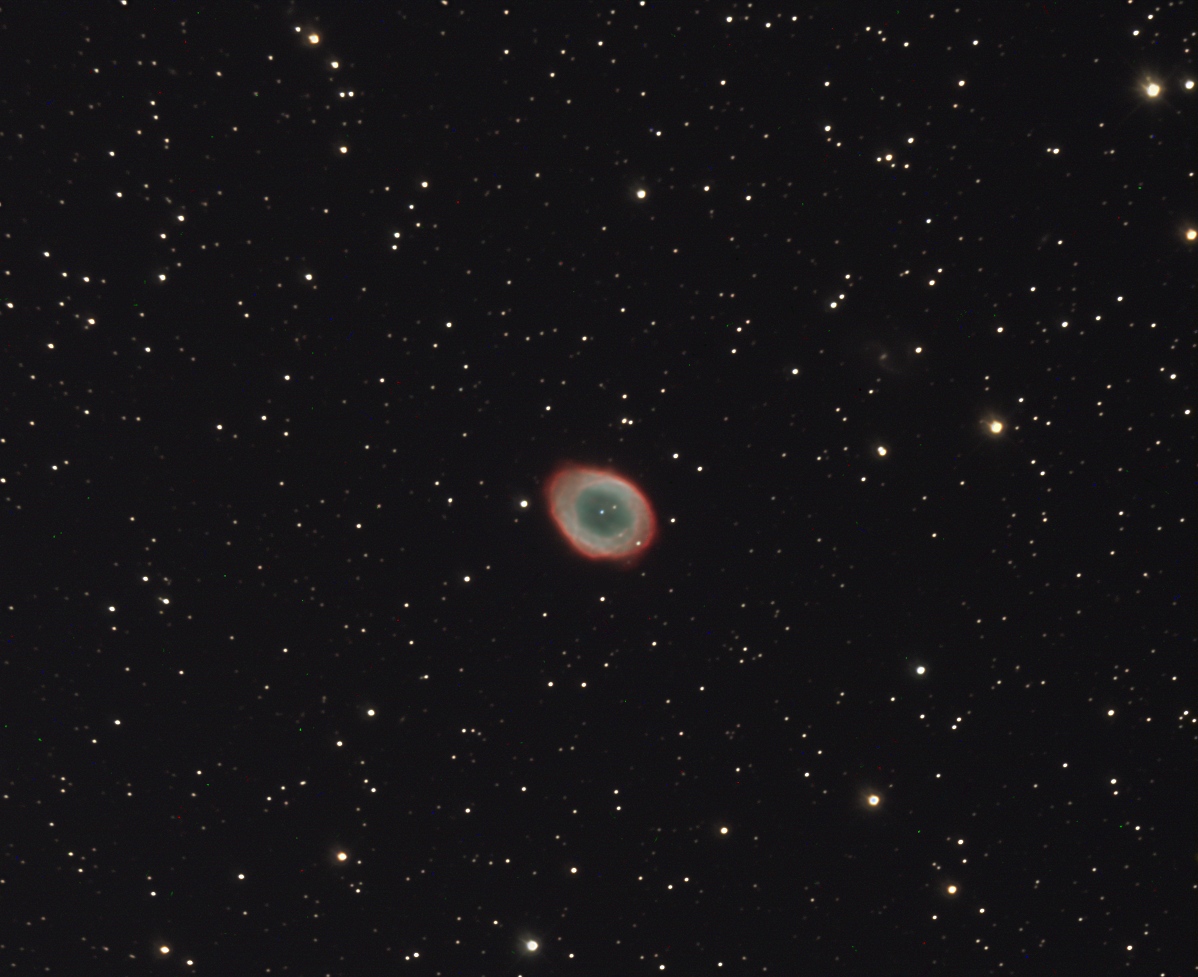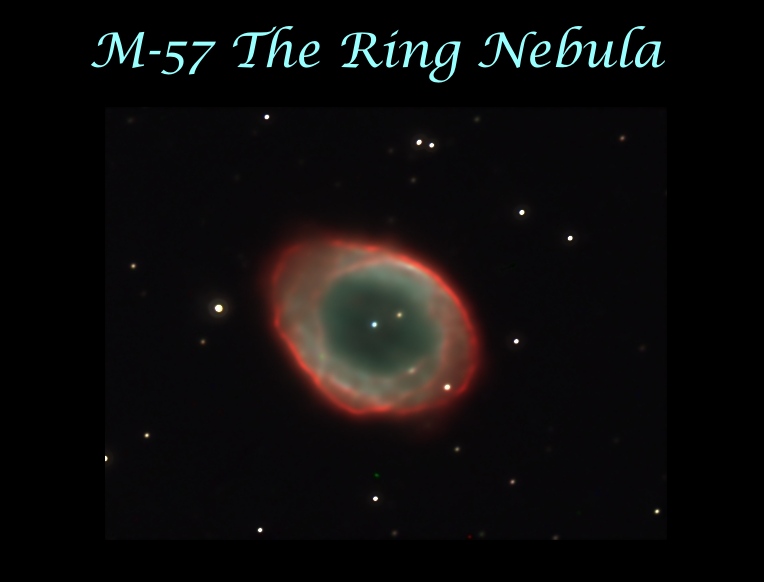
In the image below look for the spiral galaxy to the right of M-57.
|
These are CCD images (
see
color widefield version below )
taken with an SBIG STL-1301E CCD camera thru Kopernik's 20-inch F/8.1 telescope.
The total exposure time was 60 minutes. The field of view of the image
below is about 13x16 arc minutes, with North at the top. In the image below look for the spiral galaxy to the right of M-57. |
M-57 is probably the most famous Planetary Nebula in the sky. Although small, it's bright 'smoke-ring' shape is unmistakable even in a small 4-inch telescope. It is thus a favorite target at summer star parties and it never fails to delight visitors to Kopernik viewing it for the first time through our 20-inch telescope.
The background galaxy to the upper right of M-57 is 15th magnitude spiral galaxy IC 1296.
French astronomer Antoine Darquier discovered M-57 in 1779 while observing a comet. Charles Messier independently discovered it shortly thereafter. These early observers' impressions show that they did not really understand what the ring was..
Darquier: 'A very dull nebula, but perfectly outlined; as large as Jupiter and looks like a fading planet'.
Messier: ....found when looking for the comet of 1779 which passed close. It seems that this patch of light which is rounded, must be composed of very small stars but with the best telescope it is impossible to distinguish them; they are merely suspected..... M. Darquier discovered it when observing the same comet'.
M-57’s central white dwarf star (old stellar core) has an extremely high surface temperature. Ultra-violet light from this star causes oxygen in the nebula to glow a ghostly green, and hydrogen to glow red. Also, where the expanding shell runs into the interstellar gas (hydrogen) shock causes it to glow red also.
Distances to Planetary Nebulae are difficult to determine. A very rough estimate for M-57’s distance is 1,400 light years.
Planetary Nebulae: To learn more about them, click here.
George Normandin, KAS
October 27th, 2008