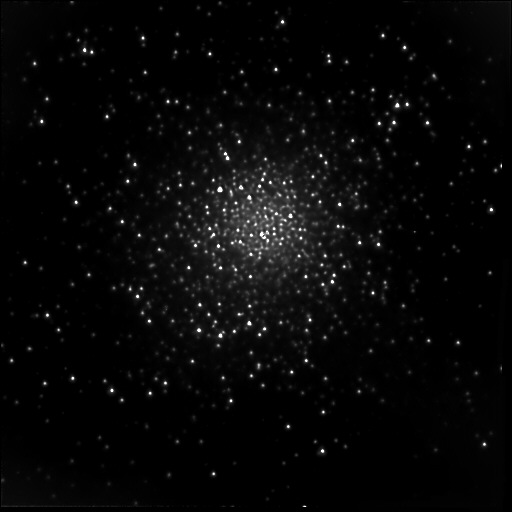
This is a 2-minute exposure taken with an SBIG ST-9E CCD camera through Kopernik's 20 inch F/8.1 telescope. Sky conditions were poor, with high cloud and a nearly full moon. The field of view is about 8 x 8 arc minutes.
Charles Messier (May 23rd, 1764): ''A fine nebula which I am sure contains no star. Round; seen well in a good sky in a telescope of 1-foot focal length. Plotted on the chart of comet of 1763. Diameter: 3 arc minutes."
Quotes from Burnham's Celestial Handbook:
'With a pair of good binoculars, the observer may obtain a glimpse of M-5 as a small fuzzy-looking star-like spot of the 7th magnitude; in a 3-inch refractor it is a bright round nebula about 5' in size. Resolution begins to be apparent in telescopes of 4-inch or larger, and the angular size increases also as fainter outlying stars come into view. Walter S. Houston thinks it attains about 27' in his 10-inch reflector, under exceptionally clear skies.....
There is a general agreement that the distance of the group is about 26,000 or 27,000 light years; a little more remote than M13. The two clusters appear to be very nearly identical in size and luminosity; the total population of each is probably in excess of half a million stars.........
The ... author (observed) M-5 through the fine 40-inch Ritchey-Chretien reflector of the U.S. Naval Observatory ...... In that first stunning view it seemed as if the fireflies of a thousand summer nights had been gathered here, frozen forever in time and suspended among the stars........'
Globular Star Cluster M-5 in the constellation of Serpens Caput is one of the great show objects of the summer sky, ranking with M-13 in Hercules and M-3 in Canes Venatici as one of the three finest globulars in the north half of the sky. Discovery of M-5 is credited to the German astronomer Gottfried Kirch, who became director of the Royal Observatory in Berlin in 1705. From an account given by his wife, Marie Margarethe, it is known that the discovery occurred on the night of May 5, 1702, while Kirch was looking for a comet. Charles Messier rediscovered M-5 in May 1764. However, it was not until 1791 that Sir William Herschel resolved it and found that it was a star cluster and not a nebula.
(Click here for the latest news on Globular Star Cluster distances and ages!!)
Click below to

George Normandin, KAS
September 18th, 2002