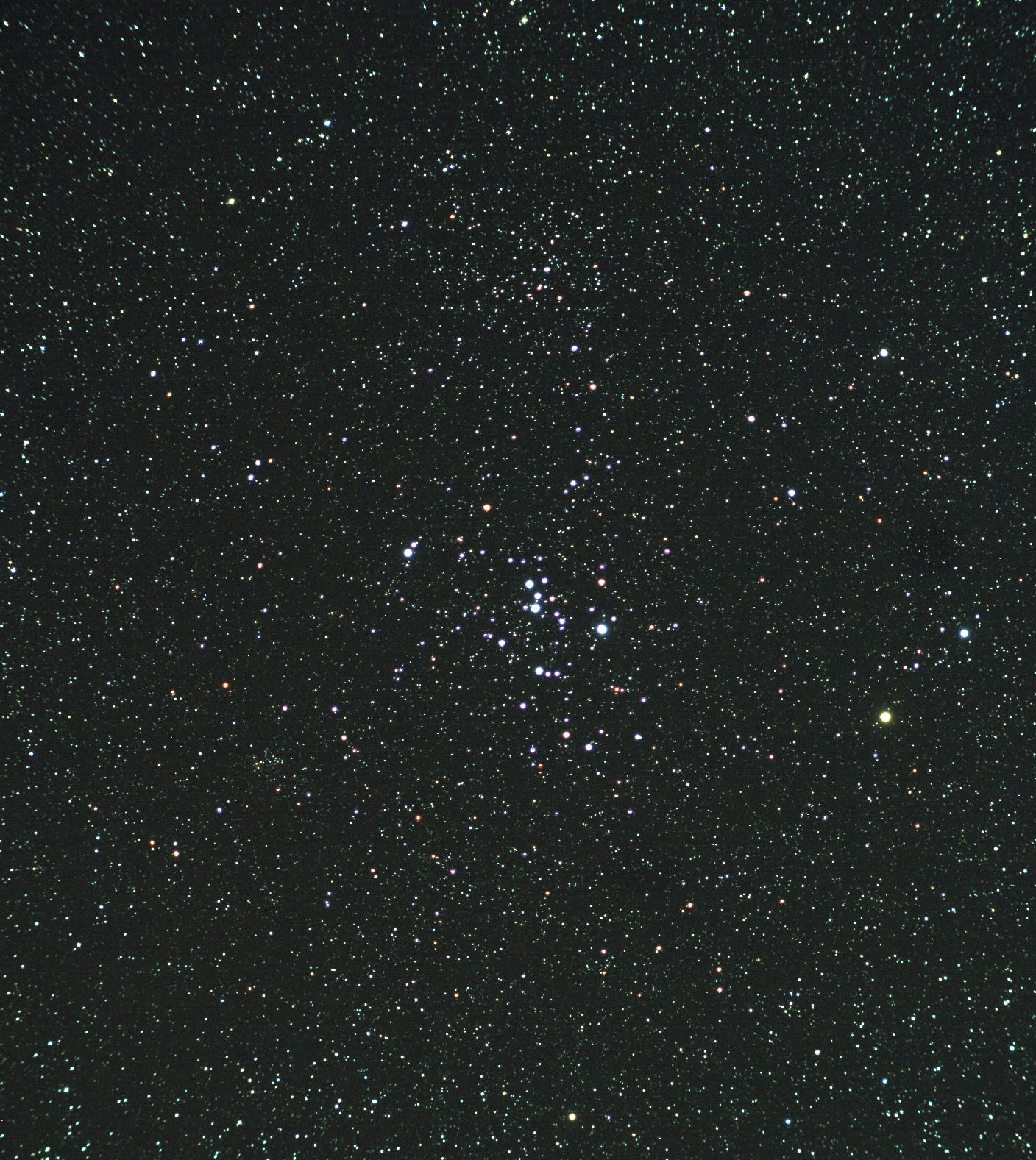
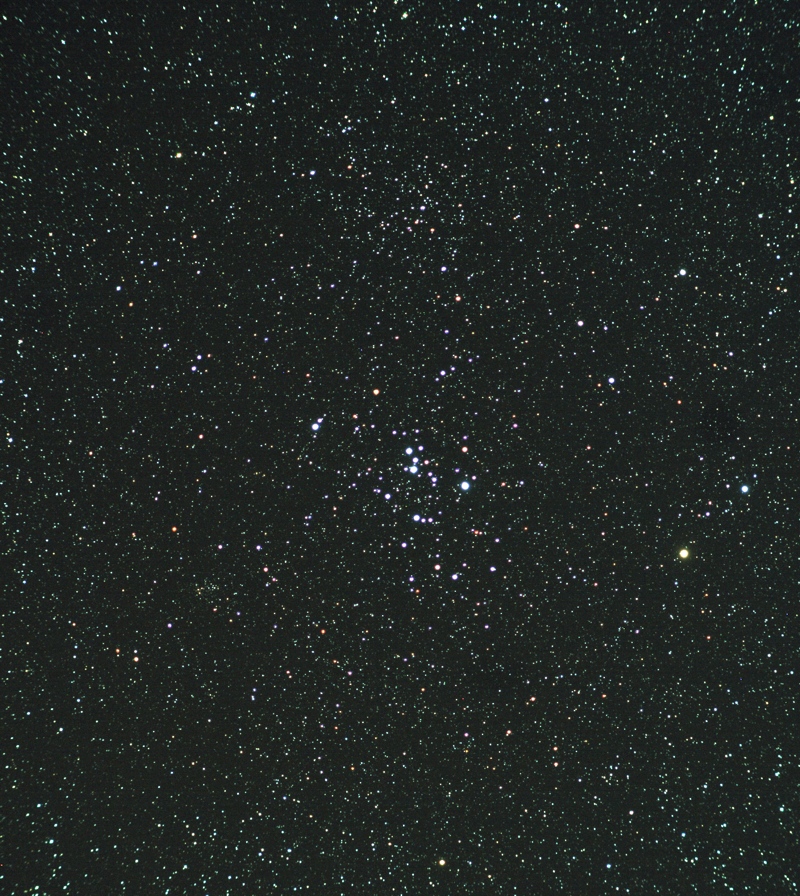
plus: Open Star Clusters NGC 2423 and NGC 2425
A Click here for a very large hi-resolution version of the image below (slow download).
Charles Messier (February 19th 1771):
'Cluster of stars, little distant from the preceding; the stars are greater [brighter]; the middle of the cluster was compared with the same star, 2 Navis. The cluster contains no nebulosity.'
Smyth:
'A double star in a loose star cluster of the Milky Way, over the Argo's stern……. Star A 7.5 magnitude, and star B 8th magnitude, both bright bluish white. They inhabit a very splendid field of large and small stars, disposed somewhat in lozenge shape…… The cluster was not registered till 1785 [actually it was seen by Messier but wrongly positioned by him]……….'
Quote from Dreyer's New General Catalog(NGC) for NGC 2422:
'Cluster, bright, very large, westward rich in stars, stars large and small; = M47.'
Quote from Deep Sky Field Guide to Uranometria 2000:
"Moderately rich in bright and faint stars with a strong central concentration; detached. Number of stars: 117. Magnitude of brightest star: 5.0"
M-47 is a loose Open Star Cluster in Puppis that is located very close to M-46. Both of these objects are easily visible in binoculars. However, thanks to its bright stars, M-47 is the most noticeable cluster in the area. Just to the north is the dimmer open cluster NGC 2423, and the small dim cluster NGC 2425 is in the same area, but it requires an 8-inch or larger telescope to see easily. The cluster lies approximately 1,600 light years away and spans a diameter of about 12 light years. It is receding from us at 9 kilometers per second. The age of the cluster is estimated to be 78 million years. Two bright members of the cluster are classed as K giants and are orange in color, while the remaining stars are bright blue giants. Each of these stars is approximately 200 times the luminosity of our sun.
George Normandin, KAS
March 1st, 2008