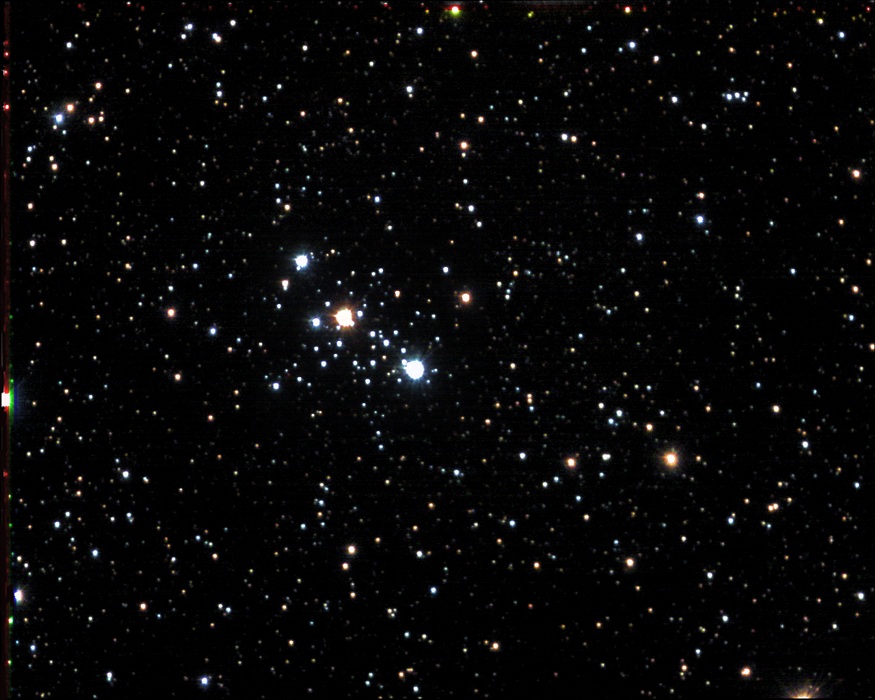
Charles Messier:
(from a description provided by Mechain) ''A cluster of stars..... between eta and delta of the leg of Cassiopeia.''
Smyth:
''Cluster a fan shaped group diverging from a sharp star in the north east quadrant. Brilliant from the flash of a score of its larger members four principal ones of which are from 7 to 9 magnitude.''
D'Arrest:
''(Includes) a beautiful 10th magnitude reddish star prominent, its color is rose tinted. An irregular cluster of 9, 10, 11th magnitude stars. Size 9 arc minutes approximately."
This Open Star Cluster in the Constellation of Cassiopeia was discovered by Pierre Méchain in 1781 and Messier included it as the last object in his published catalog without actually observing it himself. Based on Messier's notes and other sources most modern listings of the Messier Catalog include "M-104" thru "M-110", but these were not in the original.
M-103 is a rather loose cluster and there is not a general agreement on its distance or the number of members. The most recent modern estimates place it at 8,000 to 9,000 Light Years and as having a total of 172 member stars. Earlier visual estimates were more on the order of 40 to 60 members. At the above distance the cluster would be about 14 light years in diameter. The latest age estimates are around 25 million years based on the fact that there are no truly bright blue stars, which implies that they have already died as supernovae. For more info and a picture taken with the Kitt Peak National Observatory's 2.1-meter telescope, click here.
Click below to

George Normandin, KAS
November 19th, 2005