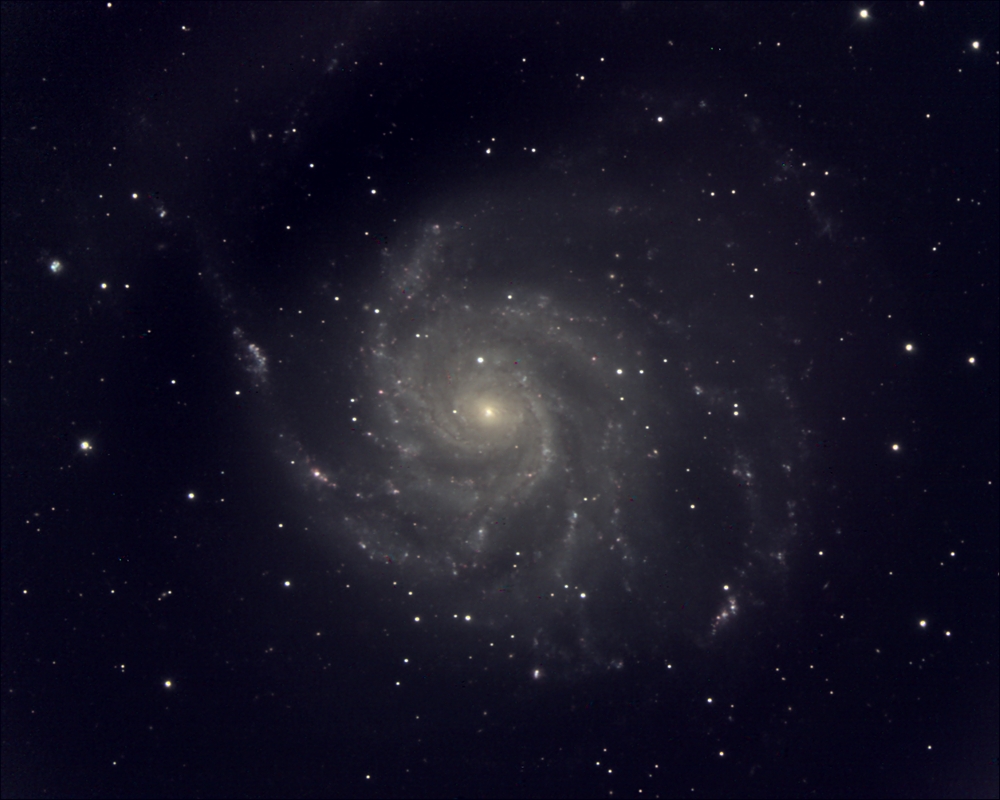
This is a 70 minute exposure with an
SBIG STL-1301E CCD camera thru Kopernik's 20-inch RC Cassegrain working
at F/5.2. The field of view is about 20x24 arc minutes.
This is a 70 minute exposure with an
SBIG STL-1301E CCD camera thru Kopernik's 20-inch RC Cassegrain working
at F/5.2. The field of view is about 20x24 arc minutes.
Click here to see images of M-101 taken with the Hubble, Spitzer, and Chandra Space Telescopes in various wavelengths. Large prints of these images are on display at Kopernik Observatory & Science Center.
Quote by Charles Messier:
(March 27th, 1781) Nebula without star, very obscure
and pretty large, 6' or 7' diameter between the left hand of Bootes and
the tail of the Great Bear. Difficult to distinguish when graticule lit.?
Quote from Dreyer's New General Catalog(NGC):
"Pretty bright, very large, irregularly round, gradually, very abruptly much brighter middle bright small nucleus; = M101."
Pierre Mechain discovered this large face-on spiral galaxy in 1781.
M-101 is relatively nearby galaxy in the constellation of Ursa Major and is the most luminous member of a rich galaxy group. M-101 is tidally interacting with NGC 5474, NGC 5477, and Ho IV. M-101 covers a large angular size, nearly as large as the full moon. Although bright it's light is spread over a large area and thus the surface brightness is rather low. This makes M-101 a rather difficult object to observe or image. Because of the large size it is best seen and imaged in small telescopes. The Kopernik image was thus made with a 80 mm refractor rather than our 20 inch telescope.
M101 is the prototype of the multiple-arm galaxies of the Sc type. Although many separate arms exist in the outer regions, each one can be traced from a branching of two principal dust arms that begin in the nucleus. They cannot be traced as individual arms but rather as separate segments which, when taken together, form a rough spiral pattern. The outer arms are highly branched.
George Normandin, KAS
July 22nd, 2009